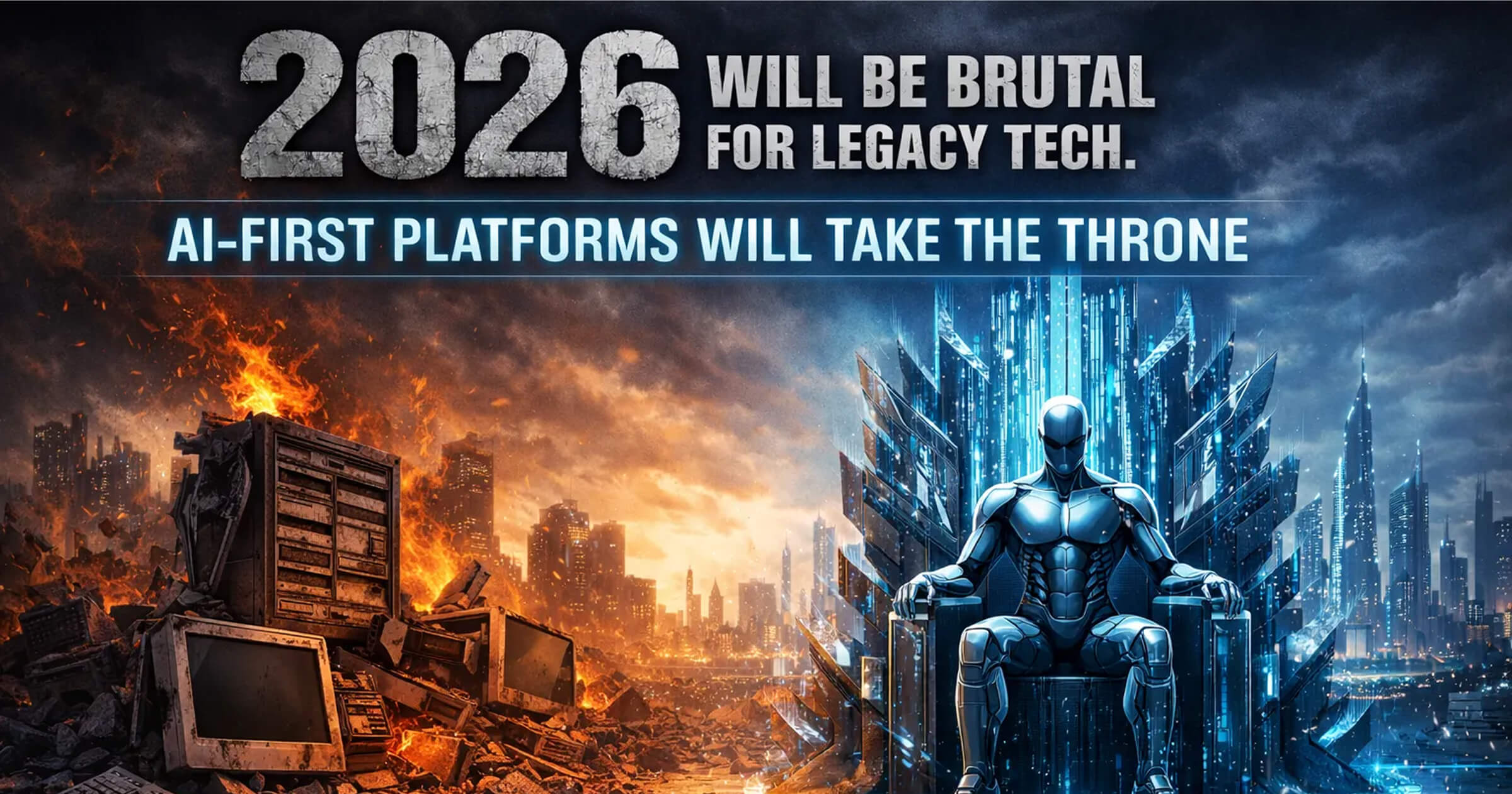
For more than a decade, enterprises have been drowning in point products, dozens of tools stacked on top of each other, each promising visibility, automation, or analytics. Yet none of them delivered what organizations actually needed: outcomes.
In 2026, that changes. AI is no longer an assistant bolted onto legacy systems. It’s becoming the operating system for cybersecurity, IT, and enterprise workflows. And the companies built on agentic architectures not cloud-first or workflow-first models are the ones rewriting the rules.
Below are the major forces that will define 2026, and why they signal the most significant shift since the rise of cloud computing.
The Collapse of Point-Product Cybersecurity
Point products have officially reached their saturation point. Enterprises are running 70–120 tools across security and IT, yet still struggle with alert fatigue, analyst burnout, and fragmented data.
In 2026, the market finally acknowledges what insiders have known for years: no single-feature product can compete with an AI system that can read, reason, act, and improve over time.
AI agents are now capable of executing complex workflows end-to-end, from threat detection to investigation, response, and audit. Instead of stitching together dashboards, enterprises are shifting to horizontal, agentic platforms that break down silos. This is the first year CISOs begin sunsetting tools rather than adding more.
Expect the valuation gap between AI-first platforms and legacy cybersecurity vendors to widen sharply. A wave of consolidation will follow.
Agentic Platforms Become the New Digital Workforce
The most important shift of 2026 is the rise of agentic platforms where systems composed of autonomous and semi-autonomous agents collaborate, learn from feedback, and deliver operational outcomes.
Unlike chatbots or workflow engines, agentic systems operate more like digital workers:
- They understand enterprise context.
- They coordinate across identity, endpoint, network, and cloud.
- They adapt from human reinforcement.
- They reduce manual workloads by orders of magnitude.
For enterprises, this means the first real path to scalable digital labor. For vendors, it means the next $50–100B category is already emerging.
By the end of 2026, agentic platforms will become the most sought-after acquisition target for hyperscalers and cybersecurity giants, the same way cloud platforms were a decade ago.
Legacy Vendors Lose Ground In an AI-First World
Legacy enterprise software companies built around rules engines, ticketing systems, or static analytics will face their toughest year yet. The problem isn’t that they lack AI features. It’s that their architectures were never designed to support reasoning systems that operate continuously and autonomously.
AI-first companies move faster, deploy faster, and deliver outcomes traditional vendors simply can’t match. Their systems:
- require fewer integrations,
- learn from operational behavior,
- and collapse dozens of workflows into a single agentic mesh.
In 2026, customers will start questioning why they need four to five categories of tooling when a single AI-native system can do the work. Expect several well-known cybersecurity and IT vendors to see revenue declines, restructuring, or to become acquisition targets themselves.
Token Costs Collapse And AI Becomes Nearly Free To Use
The economics of AI shift dramatically in 2026. Token costs the basic unit of LLM inference will drop by 70–90% as specialized AI hardware, quantization techniques, and MoE-based architectures mature. This reduction is not incremental it’s transformative. Once inference becomes cheap, always-on agents become feasible.
Security operations, IT workflows, compliance cycles, and monitoring systems will all run continuous, AI-driven processes that were previously cost-prohibitive. Cheap tokens unlock a new era: AI not as a feature, but as infrastructure.
China Introduces LLMs That Shift the Global Balance
Perhaps the most geopolitically important trend of 2026 will be the rapid rise of Chinese LLMs that rival and in some cases surpass the performance of leading Western models at a fraction of the training and inference cost.
Chinese labs have leaned heavily into:
- low-precision training,
- lightweight architectures,
- massive multilingual corpora,
- and integrated agentic reasoning modules.
These models will expand quickly across Asia, Africa, LATAM, and emerging economies, forcing Western enterprises and regulators to confront a new competitive reality: AI supremacy is no longer regional.
The global cost curve for AI will fall even faster, and the competitive pressure this creates will be profound.
AI Talent Wars Escalate to Unprecedented Levels
The war for AI talent will intense in 2023–2025 and reaches a new peak in 2026. Microsoft, Google, OpenAI, Anthropic, Amazon, Meta, and a handful of elite AI-first startups will offer compensation packages that break previous benchmarks.
Top-tier LLM researchers, agentic system architects, and reinforcement learning experts will routinely receive $10M–$20M+ packages. Acqui-hires will become one of the fastest ways for companies to acquire scarce skills.
This has a secondary effect wherelegacy vendors simply won’t be able to keep up. Without competitive talent, they’ll struggle to innovate and will fall even further behind AI-first competitors.
Cybersecurity and AI Fully Converge
The most meaningful shift of 2026 is cultural: cybersecurity and AI cease to be separate domains.
SOCs won’t just use AI — they will operate with AI. Agentic systems will:
- suppress alerts automatically,
- run investigations in seconds,
- correlate exposures across cloud, identity, endpoint, and network,
- generate remediations,
- validate changes,
- and maintain continuous controls.
By the end of 2026, large enterprises will see 30% or more of SOC workflows executed by agents, not humans.
This is the year AI transitions from a co-pilot to a co-worker.
The Bottom Line: 2026 Belongs to AI-First Companies
The market is entering a once-in-a-generation transition. The companies that win will be the ones that rebuild for an agentic, AI-native world not those that bolt AI onto legacy workflows. AI is the new architecture, agents are the new workforce and 2026 is the year enterprises finally realize the old stack cannot compete with what comes next.